Privacy First
Uploaded files are automatically and permanently deleted within two hours.
Automatic deletion

Create a MOBI e-book from an EPUB for early Kindle models, legacy reading apps and anyone who specifically needs the format
The EPUB is unpacked, its HTML and CSS are normalised, and calibre's MOBI writer produces a Mobipocket file with an embedded table of contents and cover. The text remains reflowable, so font size and margins stay adjustable on the device.
Only DRM-free books can be converted. Books from Kobo, Google Play or Adobe Digital Editions with DRM will fail.
Structure, images, cover and chapter list are mapped into the MOBI format.
Transfer by USB into the Kindle's documents folder or open the file in a MOBI-capable reader app.
A table of contents is generated from the EPUB's navigation document so the Go To menu works on the Kindle.
The cover image is embedded and shows in the library view.
Font size, line spacing and orientation remain adjustable, unlike a PDF.
Several EPUBs in one upload are returned as separate MOBI files in a ZIP.
Backed by 10+ years of engineering expertise in large-scale data and scientific computing, it’s built for real-world document workflows that require accurate layout preservation, strict privacy, and dependable, high-level performance.
Uploaded files are automatically and permanently deleted within two hours.
Rated 5 stars on Trustpilot for speed, reliability, and ease of use.
Referenced in published research and used for interview transcription and qualitative data analysis.
MOBI had a long run as the Kindle's format, which is why so many guides still tell people to convert to it. Today the honest answer is that most readers should not. Current Kindles read AZW3 natively and accept EPUB through Send to Kindle, and the Kindle apps on phones and tablets open EPUB directly after Amazon's conversion. MOBI remains the right choice for the original Kindle generations from 2007 to 2010, for some discontinued e-readers and apps such as older versions of FBReader and Mobipocket Reader, and for workflows that explicitly require it, for instance certain document management or publishing pipelines. If that is you, this converter does the job with calibre's well-tested writer.
ebook-convert reads the EPUB package, resolves the spine order, flattens the CSS into the limited styling MOBI supports and builds a Mobipocket file with an NCX table of contents and the cover image. Chapter breaks are detected from the EPUB's navigation document and from heading tags. Images are kept at their original resolution up to the format's limits. Because MOBI uses a single HTML-like stream, some page-level CSS such as floats and fixed widths is simplified, which is why novels convert flawlessly while textbooks may need checking.
For regular conversions or to tweak settings, calibre on your own computer is worth installing: it is free and open source. The steps are short.
Step 1: Click Add books and choose the EPUB.

Step 2: Right-click the book, choose Convert books, then Convert individually.

Step 3: Select MOBI as the output format and click OK. The new file is saved next to the original; Open containing folder in the context menu shows it.
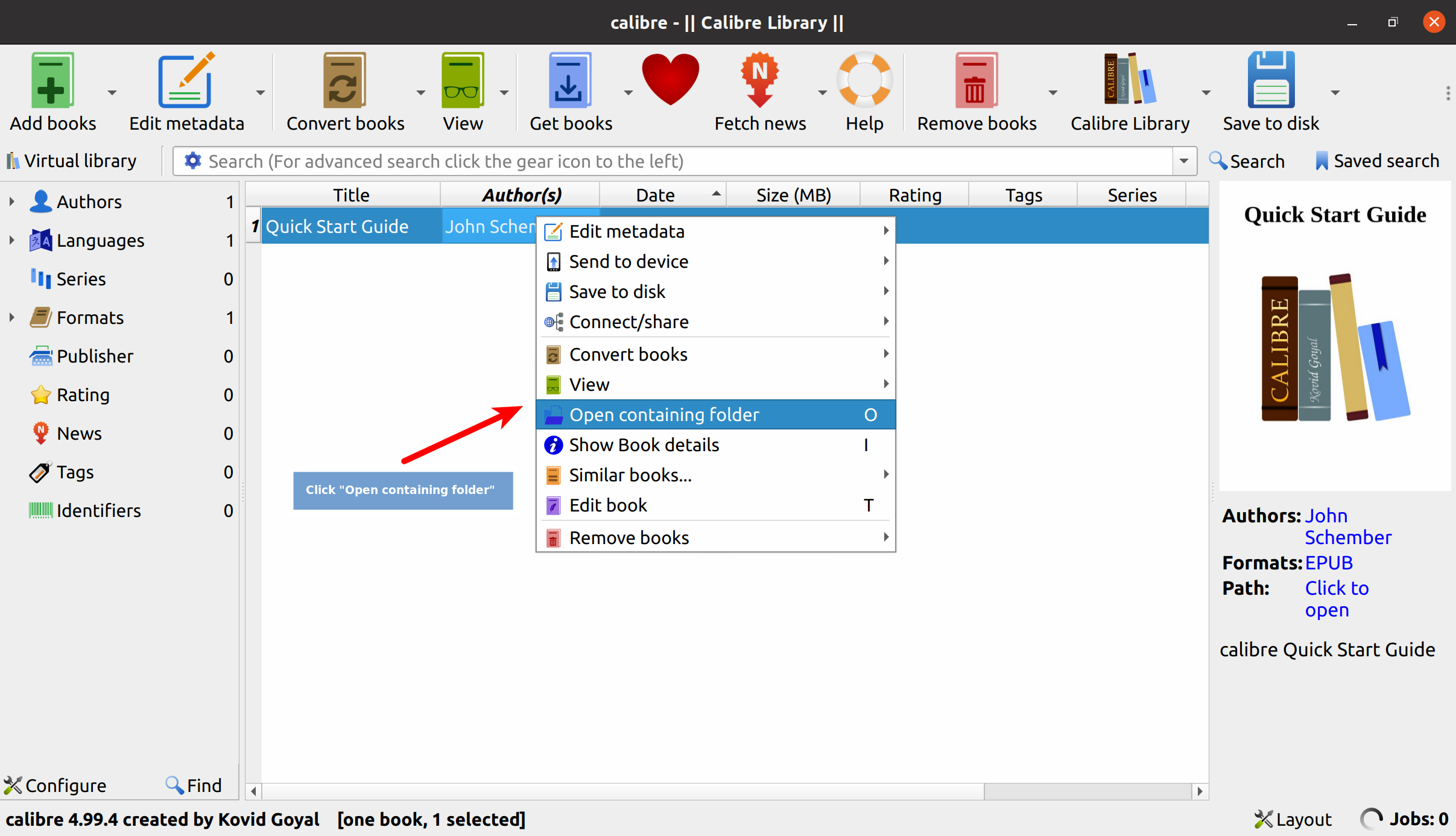
On Linux and macOS the same engine is available from the terminal: ebook-convert input.epub output.mobi.
Usually not. Every Kindle sold since 2011 natively reads AZW3 (Kindle Format 8), and since 2022 Amazon's Send to Kindle service accepts EPUB directly and converts it on their side. MOBI is only required for the Kindle 1, Kindle 2, Kindle DX and Kindle Keyboard, and for some old reading apps. If you own a newer Kindle, convert to AZW3 for the best typography or simply email the EPUB to your Kindle address.
MOBI dates from 2000 and the Mobipocket company Amazon bought in 2005. Its formatting model predates CSS support, cannot embed fonts and handles tables and complex layouts poorly. Amazon replaced it with KF8 in 2011 and removed MOBI from Send to Kindle in August 2022. Existing MOBI files still open on the devices by USB; they just cannot be delivered wirelessly any more.
Connect the Kindle via USB, open it as a drive and copy the file into the documents folder, then eject the device. On very old Kindles the file may take a moment to index. Email delivery is no longer possible for MOBI.
Reasonably. Text, headings, images, lists and simple tables convert well. Embedded fonts, drop caps, text boxes and advanced CSS are simplified because the MOBI format cannot represent them. For books that rely on precise formatting, AZW3 is the better target.
Protected EPUBs cannot be converted. The converter needs to read the book's contents, which DRM prevents, and removing DRM is not something we do. Books from DRM-free stores, library books after the loan has ended do not count, and your own documents convert without problems.
MOBI files are usually somewhat larger than EPUB because older MOBI readers required a bundled copy of the book in the legacy format alongside the images. A 2 MB EPUB often becomes a 3 to 4 MB MOBI. The limit for old Kindles is 50 MB per book.
The EPUB Format |
|
| Name | electronic publication |
| Extension | .epub |
| MIME Type(s) | application/epub+zip |
| Description | EPUB (“electronic publication”) is an open standard for reflowable ebooks. It packages XHTML content, images, CSS, and metadata in a ZIP container. Text adapts to different screens, and EPUB 3 can include audio and interactivity. |
| Tools |
|
The MOBI Format |
|
| Name | Mobipocket |
| Extension | .mobi |
| MIME Type(s) | application/x-mobipocket-ebook |
| Description | MOBI (Mobipocket) is a long-standing ebook format used by many Kindle devices. It supports reflowable text, images, and basic metadata. Amazon acquired Mobipocket in 2005, and the .mobi extension has been widely used for Kindle distribution. |
| Tools |
|